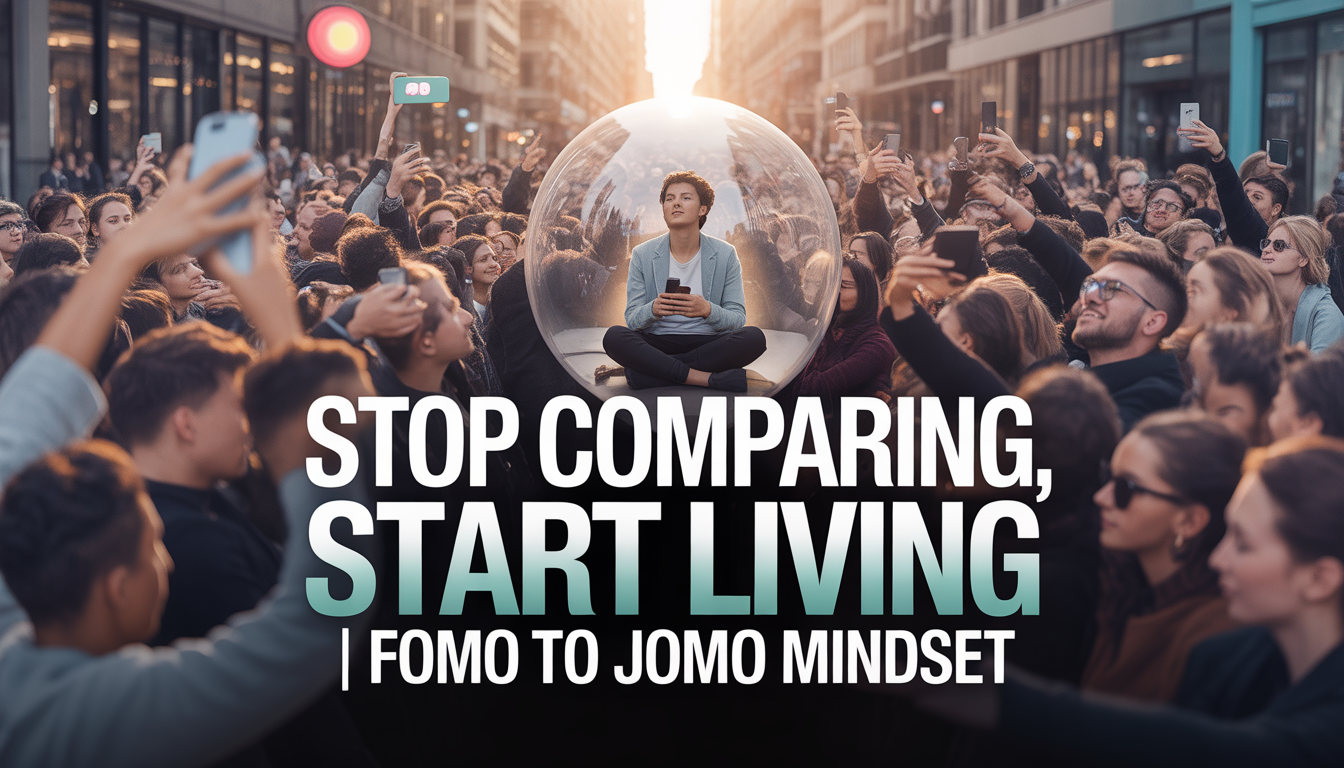
In today’s hyper-connected world, almost everyone has heard the term FOMO, Fear of Missing Out. It’s a feeling that quietly creeps into our minds when we see others doing things we are not doing. Someone is traveling while we are working. Someone is building a startup while we are still figuring out our careers. Someone is celebrating life on social media while we are sitting at home scrolling through their pictures.
FOMO to JOMO Mindset:
This constant exposure to other people’s lives creates a strange pressure. We begin to feel that we are missing something important. It feels as if everyone else is moving ahead while we are standing still. But the truth is much simpler and far more comforting: nobody can have everything. Something will always be left behind.
Understanding this simple truth can transform how we experience life. Instead of living with the fear of missing out, we can learn to embrace something much healthier and more fulfilling: JOMO – the Joy of Missing Out.
The Rise of FOMO in the Social Media Era:
The concept of comparison is not new. Even in the past, people compared their lives with those of others. Families would look at neighbors and say things like, “They have a bigger house,” or “She has better jewelry,” or “Their lifestyle is more luxurious.” But the number of things people compared themselves with was limited.
Today, however, the situation is completely different.
Social media exposes us to thousands of lives every single day. If you are working, you might see someone relaxing on a beach. When you go on vacation, you might see someone launching a startup or celebrating a promotion. When you rest, someone else seems to be hustling. When you hustle, someone else seems to be enjoying life.
This constant stream of information creates a silent pressure. It feels as though you are always behind in some area of life.
Parenting is judged. Careers are judged. Relationships are judged. Even the way we spend our free time is judged. If you discipline your child, someone will say you are too strict. If you are gentle with them, someone else will say you are not strict enough, no matter what you do, it feels like you are missing something. This is how FOMO slowly becomes a permanent mental state.
The Hidden Cost of Constant Comparison:
When we live under the influence of FOMO for a long time, it begins to affect our mental and emotional health.
Our self-worth slowly decreases. Confidence drops. We start feeling as if we are not doing enough, achieving enough, or becoming enough. This leads to a dangerous pattern. We start trying to do everything at once.
We try to build careers, maintain relationships, travel more, earn more money, stay fit, develop hobbies, maintain social lives, and remain productive all at the same time. In the rush to keep up with everyone else, we start moving faster and faster.
But when life becomes a race, something important is sacrificed. That something is ourselves. Family needs time. Work needs time. Friends need time. Business needs time. But the one thing that disappears from the schedule is personal time. The time when we simply exist without pressure slowly, we begin to miss out on the most important person in our lives: ourselves.
Why Nobody Can Have It All:
One of the biggest illusions created by modern culture is the idea that a person can have everything simultaneously.
In reality, life always involves trade-offs.
Someone who builds a massive business sacrifices time. Someone who spends time with family sacrifices career growth. Someone who travels extensively may delay financial stability. Someone who focuses on inner peace may not chase material success. Every path has its own rewards and its own sacrifices.
Yet social media hides those sacrifices and only shows the highlights. You see the successful entrepreneur, but not the sleepless nights. You see the luxury lifestyle but not the years of struggle behind it. You see a happy family, but not the challenges they face privately. When we compare our full life with someone else’s highlight reel, we naturally feel incomplete, but the truth remains unchanged: everyone is leaving something behind.
Discovering the Joy of Missing Out:
In response to FOMO, a healthier mindset has begun gaining popularity: JOMO, the Joy of Missing Out. JOMO is not about rejecting growth or ambition. It is about choosing consciously rather than reacting to social pressure.
Sometimes JOMO means deliberately saying no to things you could easily attend. You might be invited somewhere and know that it could be enjoyable. But if you don’t feel like going, you choose to stay back without guilt. You accept that missing an event does not mean missing happiness.
JOMO also appears in conversations and relationships. Sometimes we feel an urge to explain ourselves endlessly, to convince others that our choices are correct. But JOMO teaches us that not every argument needs to be won.
You can simply let things go. Perhaps the most powerful practice of JOMO is disconnecting from the phone for many people today; the phone has become a lifeline. Every free moment is filled with scrolling, notifications, or videos. But when you intentionally put your phone aside, something interesting happens.
At first, you may feel restless. You might sit quietly and wonder what to do. That discomfort exists because the phone has occupied every empty moment of your day, but if you sit with that silence for a while, old interests slowly return.
Reconnecting With the Life Beyond Screens:
Before smartphones dominated our lives, people spent their free time differently. Some people painted. Some read books. Others wrote journals or listened to music. Many enjoyed gardening, cleaning their homes, dancing, or simply sitting quietly and thinking.
These small activities created space for reflection and creativity. Today, that space has almost disappeared. When you remove distractions and allow yourself to be idle, you rediscover the simple joys that existed before constant connectivity. You might begin reading again. You might start writing, drawing, or learning something new, and most importantly, you begin spending time with yourself. This quiet space is where the joy of missing out truly begins.
The Fisherman and the Businessman:
There is a story that perfectly explains the difference between endless ambition and simple satisfaction.
A fisherman was sitting peacefully by the sea, catching fish under the warm afternoon sun. A businessman approached him and asked why he only fished for a few hours a day.
The businessman suggested that if the fisherman worked harder, he could catch more fish, sell them in the market, hire workers, buy boats, and eventually build a large fishing empire.
The fisherman listened carefully and then asked a simple question.
“What will I do after building this empire?”
The businessman replied that once he became rich, he could relax, sit in the sun, and enjoy life peacefully.
The fisherman smiled and said, “But that is exactly what I am doing right now.”
The message of the story is not that ambition is wrong. Growth and progress are valuable. Building businesses and creating opportunities can be meaningful goals. But the important question is this: Are we chasing something we truly want, or are we chasing it because everyone else is doing it?
The Illusion Created by Social Media:
Research in recent years has shown a surprising trend. Even though people today have more comfort, more technology, and more resources than previous generations, overall life satisfaction has decreased.
One major reason is constant comparison.
Through social media, a single person compares themselves with hundreds of different lifestyles in a matter of minutes.
One moment, they compare themselves with a fashion model and feel physically inadequate. A moment later, they see a successful entrepreneur and feel financially behind. Soon, they watch a spiritual teacher and feel morally incomplete. Then they see luxury brands and begin feeling materially deprived. By the end of this endless comparison cycle, the person feels lacking in every possible direction. In reality, nothing about their life has changed. But their perception of themselves has completely collapsed.
Satisfaction – The Real Measure of Life:
The true measure of a good life is not the number of achievements or possessions someone has. It is satisfying that a person may have wealth, fame, and luxury but still feel empty and dissatisfied. On the other hand, someone with simple resources may feel deeply content with their life.
If you have meaningful work, supportive relationships, a peaceful home, and basic comfort, that already forms the foundation of a fulfilling life. This does not mean people should stop growing or chasing dreams. If you have the ability and desire to achieve something bigger, you should pursue it. But growth should come from passion, not from fear of falling behind.
The Wisdom of Wanting Less:
There is a famous story involving Alexander the Great and the philosopher Diogenes.
When Alexander asked Diogenes if he could grant him any wish, the philosopher simply replied, “Yes. Please step aside. You are blocking my sunlight.”
Alexander had conquered vast territories and possessed enormous power, yet Diogenes needed nothing from him.
The story carries a profound lesson.
The person who desires the least is often the richest. Satisfaction does not come from accumulating endless things. It comes from reducing unnecessary desires.
When desires multiply beyond control, happiness disappears.
Living Life at Your Own Pace:
Life is not a single race where everyone must run at the same speed. Some people succeed early in life. Others discover their true path later. Some people create great achievements in youth, while others bloom in middle age or even old age.
Vincent van Gogh never knew that his paintings would become masterpieces after his lifetime. Yet he continued creating art with dedication. This reminds us that meaningful work should be done with sincerity rather than comparison. Your pace does not need to match anyone else’s pace.
Embracing JOMO Every Day:
The Joy of Missing Out is not a dramatic life decision. It is a series of small daily choices.
It is choosing rest when the world demands constant productivity. It is choosing authenticity instead of performance. It is choosing peace instead of endless comparison.
Sometimes it means staying home instead of attending every gathering. Sometimes it means ignoring the pressure to keep up with trends. Sometimes it simply means sitting quietly without touching your phone.
When you begin missing things intentionally, something surprising happens.
You start noticing life more clearly.
You observe people’s behavior. You understand their struggles. You see how many people are rushing through life without knowing why, and slowly, you begin to move differently, not slower, not faster, but more consciously.
Final Thoughts:
FOMO convinces us that happiness exists somewhere else. It tells us that we must constantly chase more experiences, more achievements, and more validation. JOMO reminds us that happiness already exists within the life we are living.
When we stop comparing and start living intentionally, satisfaction returns. Life feels lighter, calmer, and more meaningful. You do not have to attend every opportunity. You do not have to chase every trend. You do not have to win every race. Sometimes the most powerful choice is simply this:
Sit quietly, breathe deeply, and enjoy the life you already have.
FAQs:
1. What is the main difference between FOMO and JOMO?
FOMO (Fear of Missing Out) is driven by anxiety and comparison. It makes you feel like you are falling behind others. JOMO (Joy of Missing Out), on the other hand, is about conscious choice. It allows you to feel content with your decisions and enjoy your present moment without worrying about what others are doing.
2. Why does social media increase feelings of FOMO?
Social media only shows the highlights of people’s lives, not their struggles or sacrifices. When you compare your full reality with someone else’s best moments, it naturally creates a sense of inadequacy and the feeling that you are missing out.
3. Can I still be ambitious while practicing JOMO?
Yes, absolutely. JOMO does not mean giving up on goals or growth. It simply means pursuing what truly matters to you instead of chasing everything just because others are doing it. It replaces pressure with purpose.
4. How can I start shifting from FOMO to JOMO?
Start by limiting unnecessary social media use, practicing gratitude for what you already have, and making intentional choices about how you spend your time. Learn to say no without guilt and focus on what genuinely brings you peace and satisfaction.
5. Is it okay to miss opportunities or events?
Yes. Missing some opportunities is a natural part of life. You cannot do everything, and trying to do so leads to stress and burnout. Choosing what aligns with your values is more important than trying to be everywhere or do everything.