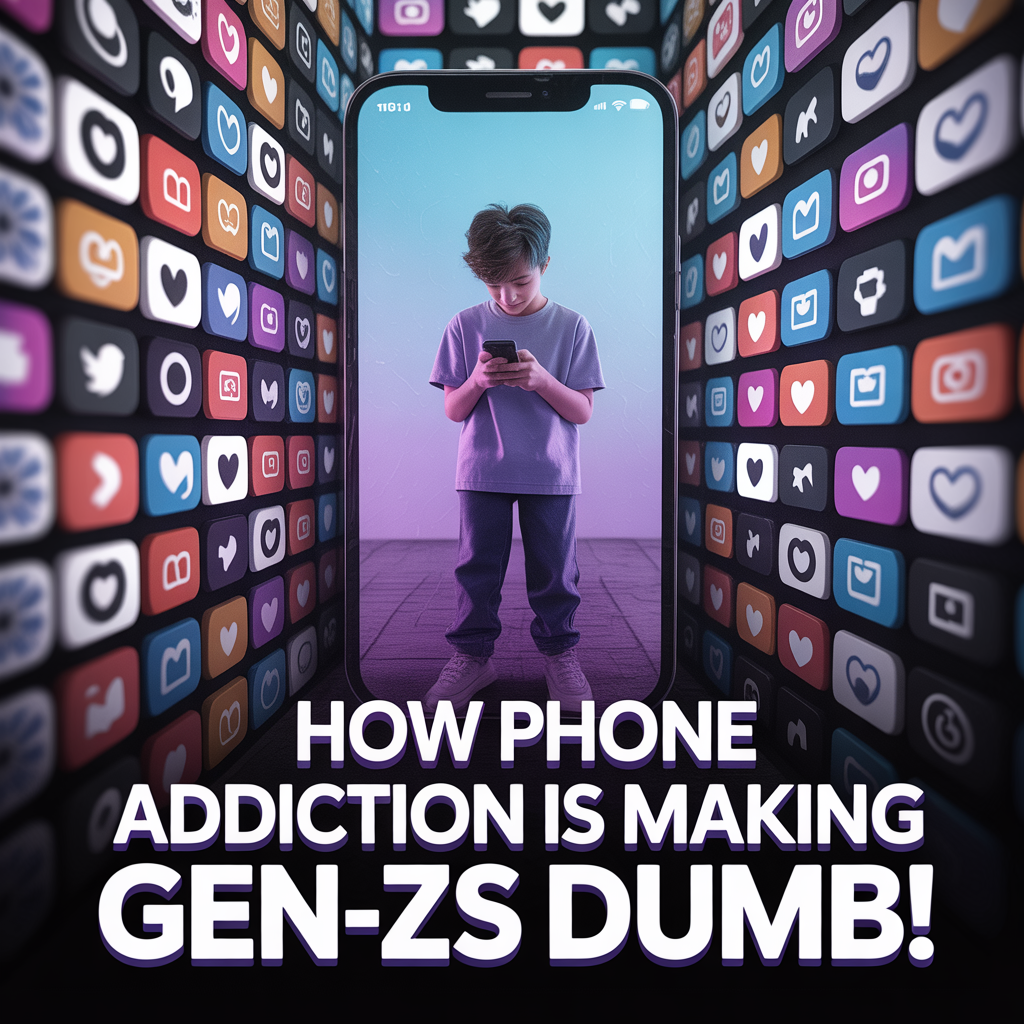
In today’s digital world, smartphones have become an inseparable part of our lives. From the moment we wake up to the moment we fall asleep, many of us are constantly checking notifications, scrolling through feeds, and refreshing apps. Platforms like Instagram, YouTube, and Meta are designed to keep us engaged for as long as possible. But what most people don’t realize is that these platforms are not just entertainment tools; they are carefully engineered systems built to capture and hold your attention.
For Gen-Z, who grew up with smartphones in their hands, the effects are even stronger. Constant scrolling, endless notifications, and the pressure of online validation are slowly damaging attention spans, focus, and even self-worth. Understanding how this addiction works is the first step toward breaking free from it.
The Dopamine Casino of Social Media:
The technology platforms that dominate our daily lives, Meta, Google, YouTube, and Instagram, are not just simple communication tools. Behind these apps is a massive ecosystem of neuroscientists, behavioral economists, psychologists, and addiction specialists. Their job is not only to improve user experience but to ensure that you spend as much time as possible on their platforms.
What many people fail to realize is that these apps are essentially designed like casinos. Every swipe, every scroll, every refresh is similar to pulling the lever on a slot machine. Sometimes you get a reward—a funny video, an interesting post, a message, or a like. Other times, you get nothing meaningful at all. But the unpredictability keeps you coming back.
This system creates what can be called a “dopamine casino.” Your brain is constantly chasing the next reward, the next notification, the next validation. The problem is that you never truly know when that reward will appear. That uncertainty is precisely what keeps you hooked.
Even content creators who upload videos or posts on these platforms do not fully understand how the algorithms work. Everyone tries to produce the best content possible, hoping the algorithm will reward them. But for the average user, the result is endless scrolling and hours lost every single day.
The Psychology of Variable Rewards:
The secret weapon behind social media addiction is something psychologists call the variable ratio reinforcement schedule. This is one of the most powerful behavioral mechanisms known in psychology.
In simple terms, it means you receive rewards at unpredictable intervals. Sometimes you get likes, sometimes comments, sometimes interesting content, and sometimes nothing. Because the reward is unpredictable, your brain keeps trying again and again.
This is the same psychological mechanism used in gambling machines. When you scroll through Instagram or watch endless videos on YouTube, you are essentially participating in a psychological experiment designed to keep you engaged.
You might occasionally find useful information or entertaining content. But to find that one valuable piece of content, you may scroll through hundreds of meaningless posts. Over time, the return on your attention becomes extremely poor.
In other words, the platform wins. Your time is lost.
What Social Media Is Doing to Your Brain:
Modern research has started to reveal alarming effects of excessive social media use on the human brain. Neuroscientists have discovered structural and functional changes in areas responsible for attention, impulse control, and focus.
Research from neuroscientist Adam Gazzaley at the University of California, San Francisco, suggests that heavy digital consumption is associated with reduced gray matter in the anterior cingulate cortex. This region of the brain is responsible for impulse control and decision-making.
When this area weakens, your ability to resist distractions decreases significantly.
Studies also show a 20 percent reduction in sustained attention ability among heavy social media users. Sustained attention is the skill required to focus deeply on a single task for long periods. It is the same ability required to prepare for exams, build complex skills, and perform meaningful intellectual work.
At the same time, there is a 40 percent increase in task switching behavior. This means people constantly jump between apps, messages, videos, and notifications. Instead of concentrating on one task, the brain becomes addicted to switching.
This behavior pattern closely resembles addiction.
The Comparison Trap That Destroys Self-Worth:
Another powerful psychological weapon used by social media platforms is the comparison algorithm. Platforms like Instagram rarely show reality. Instead, they show curated highlight reels of people’s lives.
You see someone’s promotion but not the years of struggle behind it. You see someone’s vacation but not their financial stress. You see someone’s perfect relationship but not their conflicts.
This constant exposure to idealized versions of other people’s lives slowly erodes self-worth.
Research by psychologist Andrew Przybylski shows that even ten minutes of Instagram browsing can negatively impact mood for a large percentage of users. Many people experience feelings of inadequacy, dissatisfaction with their body image, financial insecurity, and relationship anxiety.
The brain naturally compares itself to others. Social media simply amplifies this instinct to an unhealthy degree.
Instead of inspiring growth, comparison often leads to frustration and self-doubt.
The Toxic Positivity of LinkedIn Culture:
Professional platforms are not immune to these psychological dynamics. For example, LinkedIn has gradually evolved into what many researchers describe as a “performative success theatre.”
Every day, you see stories of individuals who claim they were rejected by hundreds of companies before finally landing a dream job at Google. Others share motivational narratives about starting from nothing and building billion-dollar companies.
While some of these stories are genuine, the overwhelming positivity can become toxic. Real struggles, failures, and uncertainties rarely fit into a short social media post.
As a result, people begin to feel that everyone else is succeeding while they alone are struggling.
This distorted perception of reality creates emotional pressure that damages mental health.
Why Your Brain Is Naturally Vulnerable:
To understand why social media is so addictive, we must understand how the human brain evolved.
Our brains evolved thousands of years ago in environments where survival depended on detecting movement. Any movement in the environment could signal danger or opportunity. Social media exploits this instinct perfectly.
The endless scrolling motion constantly stimulates the brain’s attention system. Every swipe activates the ancient part of your brain that searches for movement and novelty.
Humans also evolved to seek social validation. In early tribes, acceptance by the group meant survival. Being rejected by the tribe could mean death. Likes, comments, and notifications directly exploit this ancient survival instinct.
Another powerful driver is the fear of missing out (FOMO). Humans evolved in environments where missing a resource or opportunity could be dangerous. Social media constantly triggers this fear through stories, disappearing posts, and time-limited content.
All these mechanisms combine to make social media incredibly addictive.
Phantom Vibrations and Digital Dependence:
One of the strangest modern symptoms of phone addiction is something known as phantom vibration syndrome.
Many people experience the sensation that their phone is vibrating even when it is not. This happens because the brain has become so accustomed to anticipating notifications that it begins imagining them.
This phenomenon is a clear indicator that digital habits are deeply affecting our nervous system.
Phone addiction is not simply about wasting time. It alters attention patterns, emotional responses, and even perception of reality.
The First Step: Awareness:
Breaking phone addiction begins with awareness. Most people drastically underestimate how much time they spend on their devices.
The average person checks their phone nearly one hundred times per day. Many individuals spend two to three hours daily on a single app without realizing it.
The first step toward change is to measure your behavior. Look at your screen-time data and analyze which apps consume most of your time.
You should also observe the emotional triggers that lead to scrolling. Many people reach for their phones during moments of boredom, stress, anxiety, or transition between tasks.
Understanding these triggers is essential to breaking the habit.
Installing Friction to Break the Habit:
One of the most effective strategies for reducing phone addiction is something called friction engineering.
The idea is simple. Make bad habits harder to perform.
If social media apps are easily accessible on your phone’s home screen, you will automatically open them without thinking. Removing these apps from the home screen forces your brain to take additional steps before accessing them.
Logging out of social media accounts after each session also increases friction because it requires entering passwords again.
Another powerful technique is enabling grayscale mode on your phone. Without colors, social media feeds become less visually stimulating, reducing their addictive appeal.
Turning off notifications is equally important. Every notification is designed to pull your attention back into the app.
Removing these triggers weakens the habit over time.
Replacing Dopamine with Healthier Alternatives:
Your brain naturally seeks dopamine. The goal is not to eliminate dopamine but to replace unhealthy sources with healthier ones.
Morning scrolling can be replaced with exercise or a short walk. Lunchtime browsing can be replaced with conversation or an outdoor activity. Evening scrolling can be replaced with reading.
These alternative activities still provide dopamine, but they contribute to personal growth rather than distraction.
The key principle is replacement, not suppression.
Creating Phone-Free Zones:
One of the most powerful strategies for reducing phone addiction is creating physical phone-free zones.
Your bedroom should ideally remain free from smartphones. Using an analog alarm clock instead of a phone can significantly improve sleep quality and reduce the temptation to check notifications first thing in the morning.
The dining table should also be a phone-free zone. Conversations during meals strengthen relationships and improve mental well-being.
Even the bathroom should remain phone-free. Many creative insights occur during quiet moments when the brain is allowed to wander.
When phones occupy every moment of our day, those moments of mental space disappear.
Why Limiting Phone Use Gives You a Competitive Advantage:
The most surprising reality of the digital age is that focus has become extremely rare.
Because billions of people are constantly distracted by their phones, anyone who manages to control their attention immediately gains a competitive advantage.
Deep focus used to be a basic requirement for success. Today, it is a rare skill.
This means that even moderate improvements in focus can dramatically improve productivity, creativity, and learning ability.
Simply reducing phone usage can put you ahead of most people.
The Real Battle for Your Attention:
The modern world is not simply competing for your time. It is competing for your attention every notification, every video, every algorithmic recommendation is designed to capture a small piece of your focus. Over time, those small pieces accumulate into hours, days, and years.
The question is not whether technology is useful. It clearly is. The real question is whether you control your technology, or whether technology controls you, because in the battle for attention, the winner ultimately controls the direction of your life.
Conclusion:
Phone addiction is not just a harmless habit; it is reshaping the brains of an entire generation. Platforms like Instagram, YouTube, Meta, and others are engineered to capture attention using mechanisms such as variable rewards, FOMO, and social validation, creating a “dopamine casino” that keeps users endlessly scrolling. For Gen-Z, constant exposure to curated content, comparison traps, and performative success stories erodes attention span, focus, and self-worth.
Modern neuroscience shows that excessive phone use weakens impulse control, reduces sustained attention, and promotes compulsive task-switching. Breaking free requires awareness, intentional friction, healthier alternatives, and creating phone-free zones. Those who master their attention gain a rare and powerful advantage: focus, creativity, and cognitive clarity in a world dominated by distraction.
FAQs:
1. Why are smartphones so addictive for Gen-Z?
Smartphones exploit ancient brain instincts, movement detection, social validation, and fear of missing out through variable rewards, notifications, and endless scrolling, making the brain crave constant engagement.
2. How does phone addiction affect the brain?
Research shows that excessive phone use reduces gray matter in areas responsible for impulse control, decreases sustained attention by 20%, and increases task-switching behavior by 40%, making deep focus increasingly difficult.
3. What is the “dopamine casino” in social media?
It’s a term describing how unpredictable rewards from likes, comments, and content keep users hooked, similar to gambling machines, where the uncertainty drives compulsive engagement.
4. How can someone reduce phone addiction effectively?
Strategies include awareness of usage patterns, creating friction (removing apps from the home screen, logging out), enabling grayscale mode, turning off notifications, and replacing phone time with healthier activities like exercise, reading, or social interaction.
5. Why is controlling phone usage a competitive advantage?
In an age of constant digital distraction, the ability to focus deeply becomes rare. Reduced phone use improves attention, creativity, and productivity, giving those who master it a significant edge over peers.